
We Wear the Mask: Exploring the Talented Tenth and African American Political Philosophy in 21st Century Politics A Dissertation Submitted to the Graduate Faculty of the University of New Orleans in partial fulfillment of the requirements for the degree of Doctor of Philosophy in Political Science by Laurýn Tamar Minter, Ph.D.
You Can’t Sit with Us by Lauryn Tamar Minter, Ph.D.
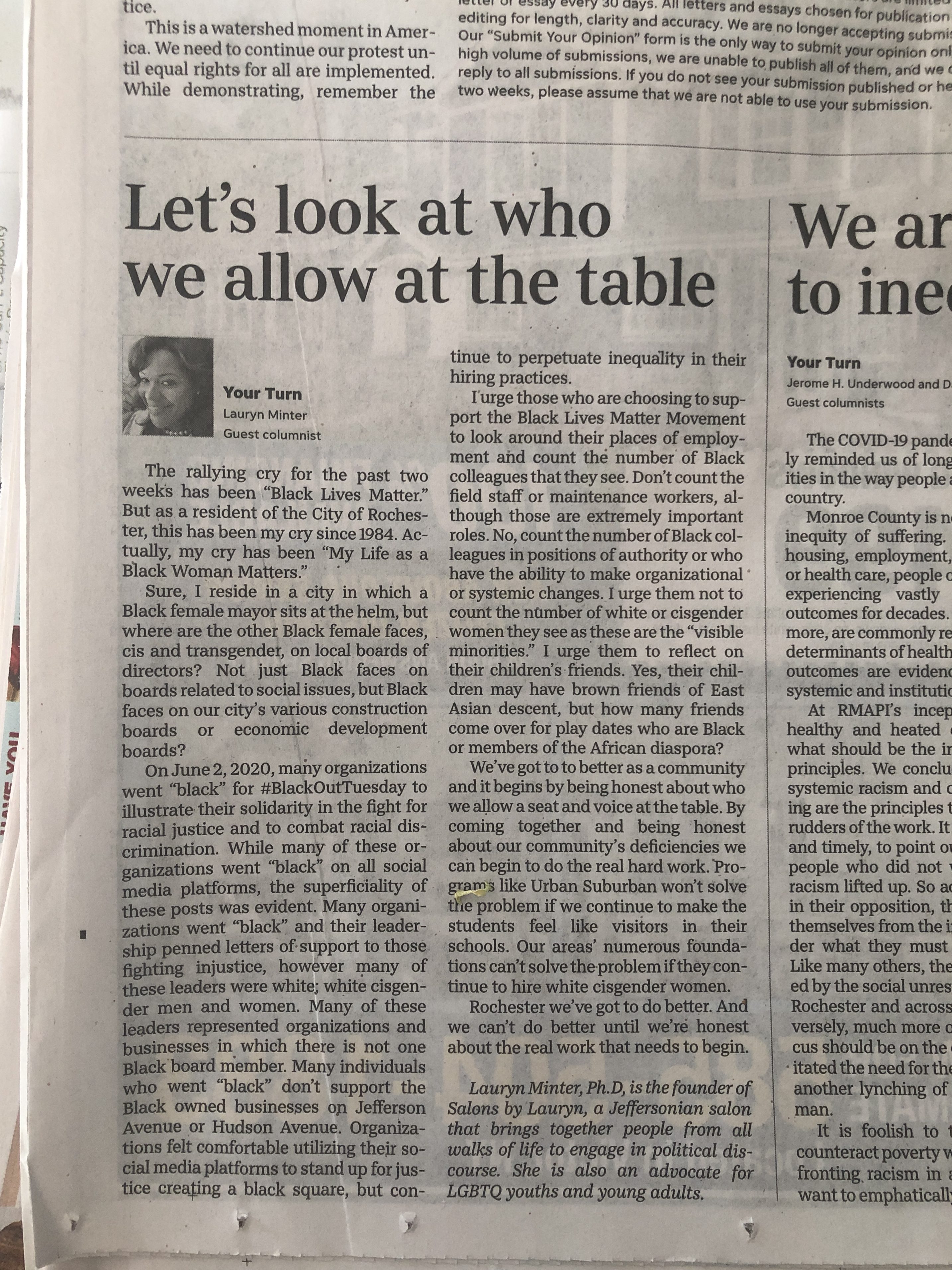
Your Organization Doesn’t Really Want Diversity, Equity, and Inclusion by Lauryn Tamar Minter, Ph.D.
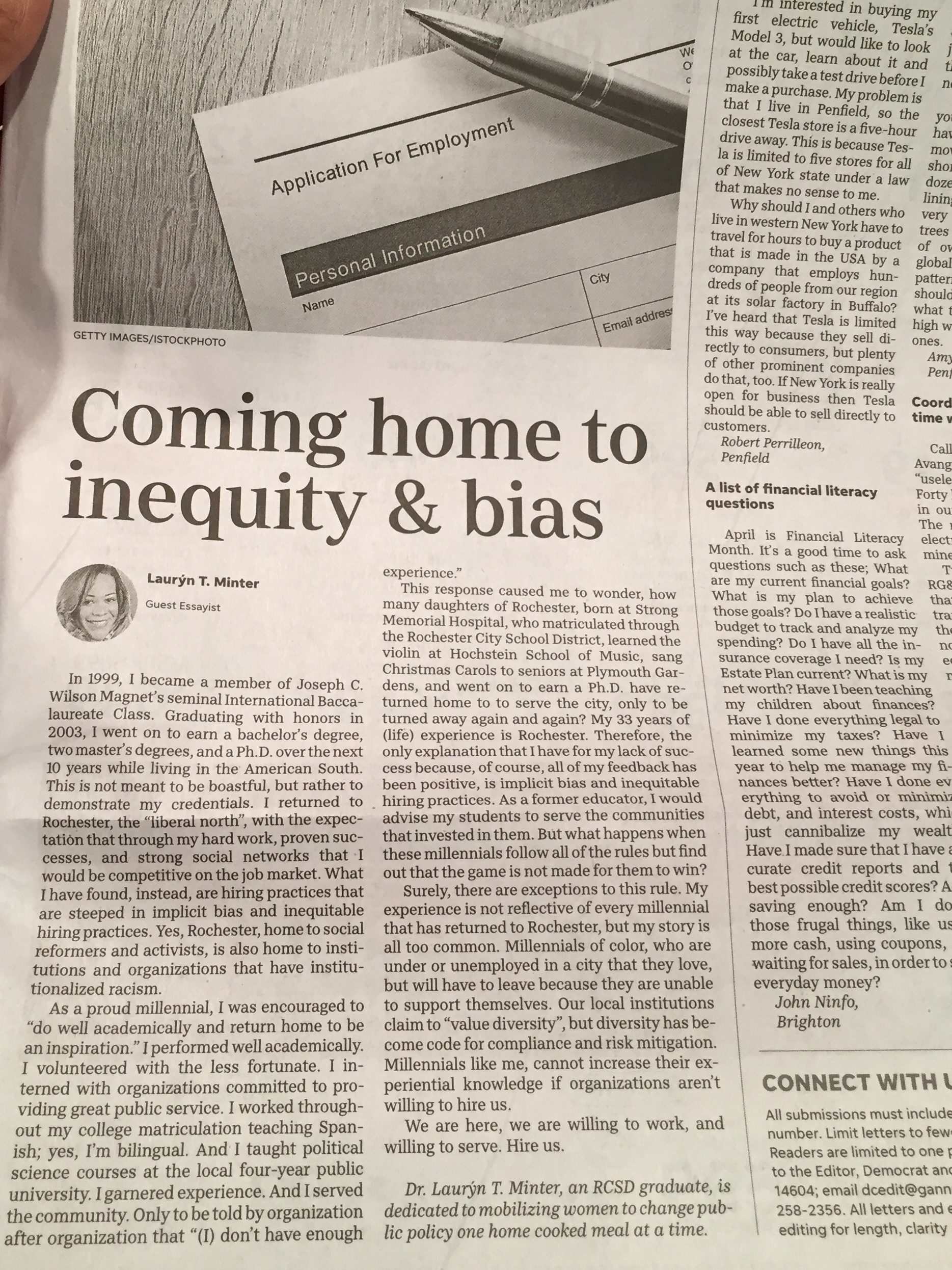
Black Lives Matter 101: Mobilizing the African Diaspora by Laurýn Tamar Minter, Ph.D.

Pining Teachers Against Students During Covid19 Pandemic by Laurýn Tamar Minter, Ph.D.
The safety of students and adults are at risk!!!! But what does the data say?
Reopening public schools is a national emergency, but the public discourse on the topic pits the safety of adult educators against students in the hardest hit school districts including those in low income, marginalized communities. But what does the data say?
From a data perspective, it is difficult to make an informed decision when President Trump’s education secretary, Betsy DeVos, declined to have her agency collect any national data on the number of coronavirus cases or outbreaks in schools. Why is data so important? Without data it is difficult to appropriately trace, isolate, or even understand the impact of school openings on the course of the pandemic, or efficacy of various safety protocols.
Hire Salons by Laurýn, Inc., today, to make informed decisions about reopening public schools.
I have an I.D.E.A. as how to Improve Your Diversity Efforts by Laurýn Tamar Minter, Ph.D.
What’s the first thing that you notice when you walk into a room? For me, as a visibly plus sized woman, I look at the chairs. If the chairs have arms, I become anxious as I anticipate the possible public embarrassment of not being able to fit comfortably in the chair and then having to request another seating accommodation. If the chairs are armless then I am still anxious as I question the weight capacity of the chairs. Yes, chairs must be a part of the public and organizational discourse on diversity, equity, and inclusion efforts.
Somehow, as we have begun to create new organizational protocols surrounding diversity efforts, many organizations have excluded accessibility. I jokingly say to folks that we purposefully refer to diversity, equity, and inclusion efforts using the acronym D.E.I. because if we said “diversity, inclusion, and equity”, then the acronym would spell D.I.E. Unfortunately, many of our community’s diversity efforts are just that: dead on arrival. But by intentionally incorporating access or accessibility to strategic plans, our organizations illustrate their commitment to diversity I.D.E.A.s in the broad sense and are truly willing to work as A.I.D.E.s to ensure that the efforts are substantive.
Creating spaces that are accessible and accommodating allows employees, clients, and other stakeholders, to show up and immediately be rockstars! By creating anonymous survey tools, to be dissiminated prior to a meeting or event, your organization can ensure that participants’ needs will be met without them being signaled out upon their arrival. While the list of accommodations that individuals may potentially need cannot be totally comprehensive, your organization can always start somewhere. Ask your employees, clients, or external stakeholders what types of accommodations would make their job easier or enhance their performance. An organization cannot be inclusive if it is not accommodating.
For many folks with various visible and invisible disabilities, their disability is their super power. Given the right accommodations at work, their productivity and creativity will increase exponentially because not only do they need those things to be successful, but they will also feel a strong sense of belonging. It is possible that your organization’s turn over rate is high or you have difficulty attracting new employees because all of your efforts are focused on diversity, equity, and inclusion with neither a substantive plan to ensure the retention of your “diverse” employees nor providing with basic accessibility tools.
This is just one I.D.E.A.

 Bethune, Baker, and Cooper Consulting Group